Alfindra Primaldhi · CC BY 3.0
About
A striking climbing plant, *Nepenthes dubia* is notable for its robust, cylindrical stem and the distinct morphology of its upper pitchers, which are characteristically reflexed beyond 180 degrees. It is endemic to the Indonesian island of Sumatra and is listed as Critically Endangered.
Field notes
Morphology
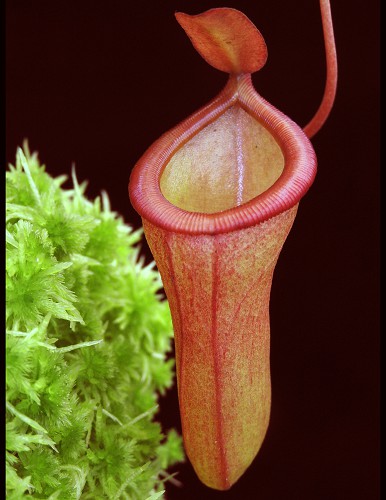
The plant is a climbing species with a stem that can reach 3 m in length and is 3 to 4 mm in diameter. Leaves are sessile, lanceolate-spathulate, and up to 10 cm long and 2 cm wide. Lower pitchers are narrowly infundibular, reaching 5 cm in height and 3.5 cm in width, with a cylindrical peristome and an ovate lid. Upper pitchers are generally larger, growing to 8 cm in height and 4 cm in width, featuring a widely infundibular upper part, a cylindrical or involute peristome (≤4 mm wide), and a narrowly cuneate lid that is characteristically reflexed beyond 180 degrees.
Distribution & habitat
Endemic to the Indonesian island of Sumatra, found at elevations ranging from 1,600 m to 2,700 m above sea level.
History & etymology
First collected on May 29, 1917, by H. A. B. Bünnemeijer on Mount Talakmau. B. H. Danser formally described *N. dubia* in 1928, noting that while it resembles *N. inermis*, the differences in the peristome and lid are significant. The lectotype specimen is Bünnemeijer 938.
Conservation
Critically Endangered (IUCN Red List, 2006) due to its extremely localized distribution.
Habitat
- Altitude
- 1,600–2,700 m
- Altitude Class
- highland
- Native To
- Sumatra, Indonesia
- IUCN Status
- Critically Endangered
Taxonomy
- Described
- 1928
- Authority
- Danser
Cultivation
- Difficulty
- intermediate
Borneo Exotics 2 listings
View all →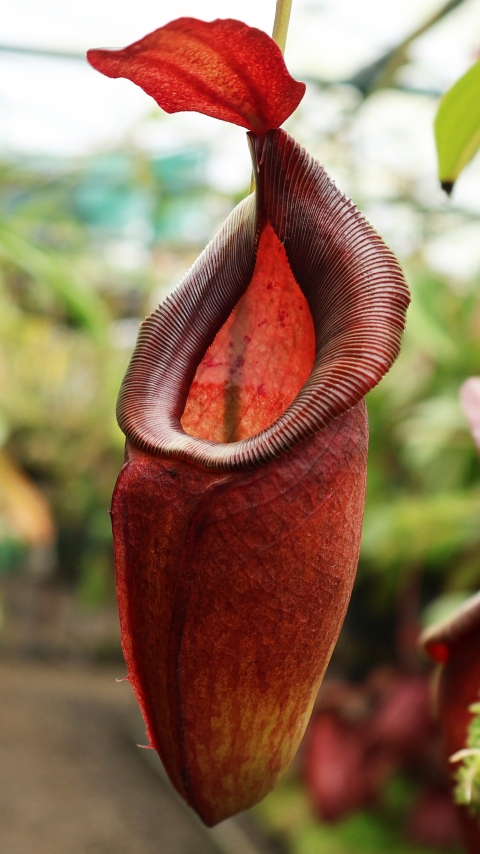
Crossed Nepenthes dubia with another species?
Register the cross — if it's not yet documented you'll be the first contributor. If someone already registered it, you'll be redirected to add your photo.