Hans Breuer · CC BY 2.0
About
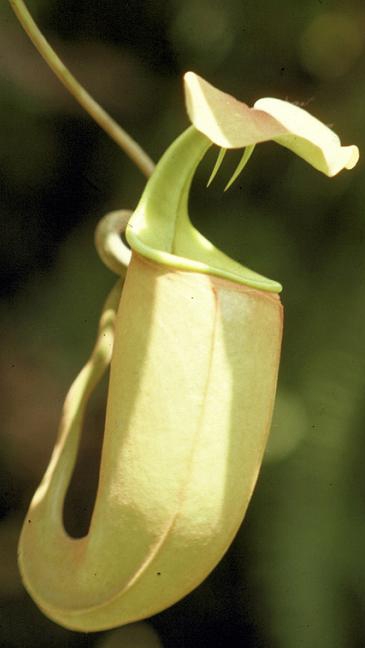
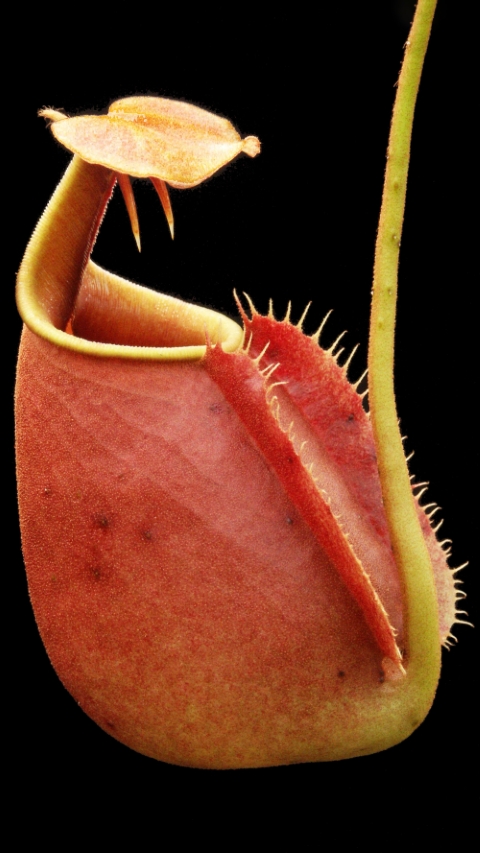
Nepenthes bicalcarata, meaning 'two-spurred,' is a large, tropical pitcher plant endemic to Borneo. It is notable for its robust habit and the presence of two prominent spines on the underside of the pitcher lid. The plant is also a myrmecophyte, maintaining a mutualistic relationship with certain ant species.
Field notes
Morphology
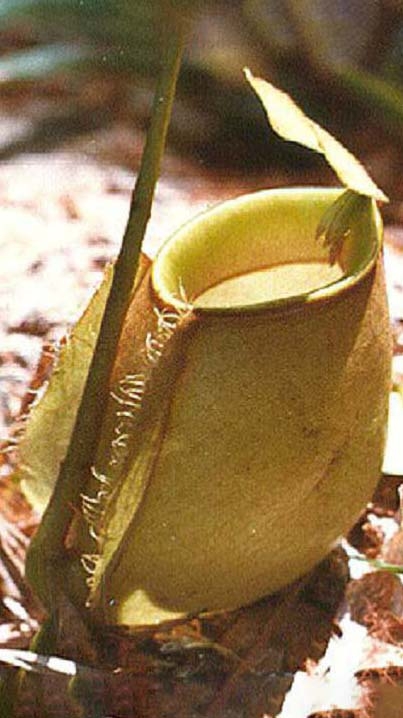
This species is a large vine, capable of climbing up to 20 meters into the forest canopy. The cylindrical stem is notably thick, measuring up to 3.5 cm in diameter, and the leaves are petiolate and coriaceous, reaching dimensions of 80 cm in length and 12 cm in width. Pitchers can grow up to 25 cm high and 16 cm wide, featuring a flattened, curved peristome and two distinct spines on the operculum. The inflorescence is paniculate, with the peduncle potentially reaching 40 cm and the rachis up to 100 cm.
Distribution & habitat
Nepenthes bicalcarata is endemic to Borneo, thriving particularly in the peat swamp forests of the western coast. It is found across regions including Sarawak, Sabah, Kalimantan, and Brunei, and can also be recorded in kerangas and white sand heath forests. The species generally occurs at altitudes below 300 meters, though records exist up to 950 meters.
Ecology
As a myrmecophyte, *N. bicalcarata* maintains a mutualistic association with the ant species *Camponotus schmitzi*, which reside in the hollow, swollen tendrils. While it lacks the highly acidic pitcher fluid and waxy zone of some relatives, the peristome is crucial for prey capture, showing a three-fold increase in trapping efficiency when wet. The two spines are thought to lure insects into a precarious position over the pitcher mouth, aiding in their fall.
Cultivation notes
The species thrives best in undisturbed peat swamp forest environments characterized by high humidity and diffused sunlight. It has a shallow root system that prefers the top layer of peat and leaf litter. While specific temperature ranges are not detailed, the habitat suggests a tropical climate. The plant is described as a robust habit, suggesting moderate difficulty for cultivation.
History & etymology
*Nepenthes bicalcarata* was formally described by Joseph Dalton Hooker in his 1873 monograph, based on specimens collected near the Lawas River in Borneo. It was introduced to Europe in 1879 by Frederick William Burbidge and subsequently cultivated at the Veitch Nursery. The name *bicalcarata* is derived from Latin, meaning 'two-spurred,' referring to the unique spines on the pitcher lid.
Conservation
The species was listed as Vulnerable on the 2006 IUCN Red List of Threatened Species. Its primary threat is habitat loss and pressure on its endemic peat swamp forest habitat in Borneo.
Habitat
- Altitude
- 0–950 m
- Altitude Class
- lowland
- Native To
- Borneo
- IUCN Status
- Vulnerable
Taxonomy
- Described
- 1873
- Authority
- Hook.f.
Cultivation
- Difficulty
- intermediate
- Temperature
- Day 28–35°C / Night 20–28°C
- Humidity
- 70–95%
Crossed N. Bicalcarata with another species?
Register the cross — if it's not yet documented you'll be the first contributor. If someone already registered it, you'll be redirected to add your photo.